Ivory: Where It Actually Comes From
Updated: 2 days ago
Ivory is most closely associated with elephants, but it also comes from the tusks and teeth of several living and extinct species.
KANDOLA WILDLIFE

Photo by Kate Brooks
When most people hear the word ivory, they picture an elephant’s tusks. That association is understandable: elephant ivory has been carved, traded and trafficked across the world for centuries, and the demand for it has driven the killing of vast numbers of elephants. But elephants are not the only source. Ivory can also come from walruses, narwhals, hippos, warthogs and sperm whales. It can even come from woolly mammoths that have been extinct for thousands of years. These materials may look similar once carved, but they come from different animals, carry different conservation risks and are governed by different laws.
Understanding where ivory actually comes from is therefore more than an anatomical lesson. It is part of understanding the wildlife trade itself.
What is ivory?
Ivory is the hard, pale material found in the tusks or large teeth of certain mammals. It consists mainly of dentine, the calcified tissue found beneath the enamel in human teeth.
A tusk is simply a tooth that extends beyond the mouth and continues growing. Depending on the species, it may be an enlarged incisor or canine tooth. Its natural purpose is not decorative. Animals use tusks for defence, feeding, digging, social displays, competition and movement through their environment.
The word ivory is often used as though it describes one uniform material. In reality, specialists can examine features such as shape, internal structure and cross-sectional patterns to help determine the species from which an object originated. Once ivory has been cut, polished or intricately carved, however, identification can become considerably more difficult.


An elephant’s tusks are elongated upper incisor teeth that continue growing throughout its life. Elephants use them to dig for water and minerals, strip bark, move objects, protect themselves and compete with other elephants. Those same tusks have also made elephants a target.
Elephant ivory has been used to produce jewellery, ornaments, carvings, piano keys, handles and religious objects. International commercial trade in elephant ivory was banned under CITES in 1989, although limited exceptions and different domestic rules still exist. Illegal trade has nevertheless continued, sustained by poaching, trafficking networks and consumer demand.
Among the different materials called ivory, elephant ivory remains the form most closely connected to large-scale wildlife trafficking and the poaching crisis facing wild elephants.

Ivory also has a long history in the Arctic, where tusked animals have been important to Indigenous communities for food, tools, art and cultural practice. That history should not be collapsed into the same category as international commercial wildlife trafficking. Subsistence harvest, traditional use and commercial trade may be treated very differently under national and international law.


Walrus
Both male and female walruses have tusks, which are elongated canine teeth. Walruses use them in social and dominance displays, for defence and to help manoeuvre their heavy bodies around ice and water. Walrus ivory has long been carved into tools, decorative objects and works of art. Today, its possession and sale are regulated differently depending on the country, the origin of the ivory and the person who harvested or worked it.


Narwhal
The narwhal’s spiral tusk is one of the most distinctive teeth in the animal kingdom. Narwhals have two teeth in the upper jaw. In most males, the left tooth grows outward into a long, counter-clockwise spiral. Some females also develop a tusk, and rare individuals may develop two.
Narwhals live in Arctic waters, and their tusks have historically been traded as rare curiosities, once helping to fuel European legends of the unicorn. Narwhals are protected and internationally regulated, and trade in their tusks is subject to controls that vary by jurisdiction.


Mammoth
Woolly mammoths disappeared thousands of years ago, but their tusks remain preserved in Arctic permafrost. As frozen ground thaws and excavation expands, mammoth ivory is recovered and sold for carving, jewellery and collectors’ pieces.
Because mammoths are extinct, their ivory is not regulated everywhere in the same way as ivory from living elephants. But the two materials can resemble each other, particularly in finished objects or online photographs. This creates an enforcement challenge. Claims that an item is made from mammoth ivory can make it harder to identify, or may be used to disguise, elephant ivory in trade.
Mammoth ivory may come from an extinct animal, but its modern market can still intersect with the conservation of a living one.


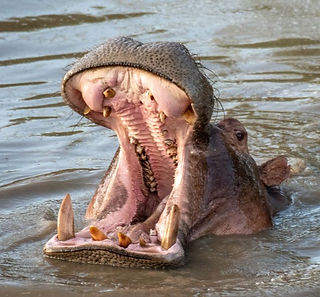
Hippos
Ivory can come from a hippopotamus’s large canine and incisor teeth. Hippo teeth are extremely hard and have been used for carvings, ornaments and dental work (18th - 19th century). Hippo ivory has also appeared as a substitute for elephant ivory.
Hippos face threats from habitat loss, conflict, hunting for meat and the trade in their teeth. Their international trade is regulated under CITES, but legality depends on the origin, documentation and laws involved.


Warthogs
A warthog’s curved tusks are enlarged canine teeth. The upper tusks grow outward and upward, while the lower pair remain shorter and sharper. Warthog ivory has been carved into jewellery, handles and small decorative objects.
Although warthog ivory is less prominent than elephant ivory, it still forms part of the wider market in animal teeth and tusks.


Sperm whales
Sperm whales do not have protruding tusks, but their large teeth have historically been carved and engraved. This form of maritime art is often known as scrimshaw.
Sperm whales are internationally protected, and modern commercial trade in whale products is heavily restricted. Antique claims do not automatically establish legality. Age, species, origin and documentation may all matter.
Why is some ivory legal?
The existence of legal ivory does not mean that modern elephant ivory is generally acceptable to trade. The term covers several different materials, histories and legal exceptions.
Mammoth ivory may be legal because it comes from an extinct animal and is often treated as a fossil rather than a product from protected living wildlife. Its trade is not regulated everywhere in the same way, however, and some jurisdictions restrict it because of concerns about mislabelling and enforcement.
Traditional Indigenous use of walrus ivory is legally recognized in some Arctic jurisdictions. Walruses have long provided food and materials to Indigenous communities, and their tusks may be carved into art and jewellery. WWF distinguishes this culturally and economically important trade from the illegal killing of elephants for ivory.
Verified antiques and pre-ban objects may qualify for limited exemptions under certain laws. Whether an object qualifies can depend on its species, age, provenance and whether it has been altered or repaired. Calling an item antique is not enough. Credible documentation may be required.
Ivory from other species may sometimes be traded under national laws or CITES permits. The rules depend on the species and jurisdiction, and legality in one country does not automatically make an item legal elsewhere.
Museums, researchers, exhibitions and musicians may also receive permission to move documented ivory specimens or objects for limited non-commercial purposes.
Crucially, an item may be legal to own but illegal to sell, export or import. Legality can change depending on what the item is, when and where it was obtained, the documentation accompanying it and what someone intends to do with it.
Why identifying the source matters
An ivory object can conceal nearly everything important about its origin. Once the material has passed through carvers, dealers, online sellers and borders, a buyer may see only a polished pendant or figurine, not the species, country, date or circumstances behind it.
That uncertainty matters for several reasons:
Different species have different levels of protection.
International rules and domestic laws are not always the same.
Regulations may distinguish between raw and worked ivory, personal and commercial use, or modern and verified antique objects.
Traditional Indigenous use may be governed differently from general commercial trade.
Similar-looking materials can complicate identification and create opportunities for mislabelling or laundering.
A seller’s description is not proof. Words such as antique, fossil, legal or mammoth should be supported by credible documentation and, where necessary, expert identification.
When you encounter ivory, ask
What species did it come from?
Where did it come from?
When was it obtained?
Can its legal origin be proven?
Knowing the source matters. Choosing not to buy it does too.
Ivory is not simply a colour, a carving or a luxury material. It began as part of an animal. Knowing which animal, and how the object entered the market, is the minimum information needed to understand what is really being bought.
Sources and further reading:


